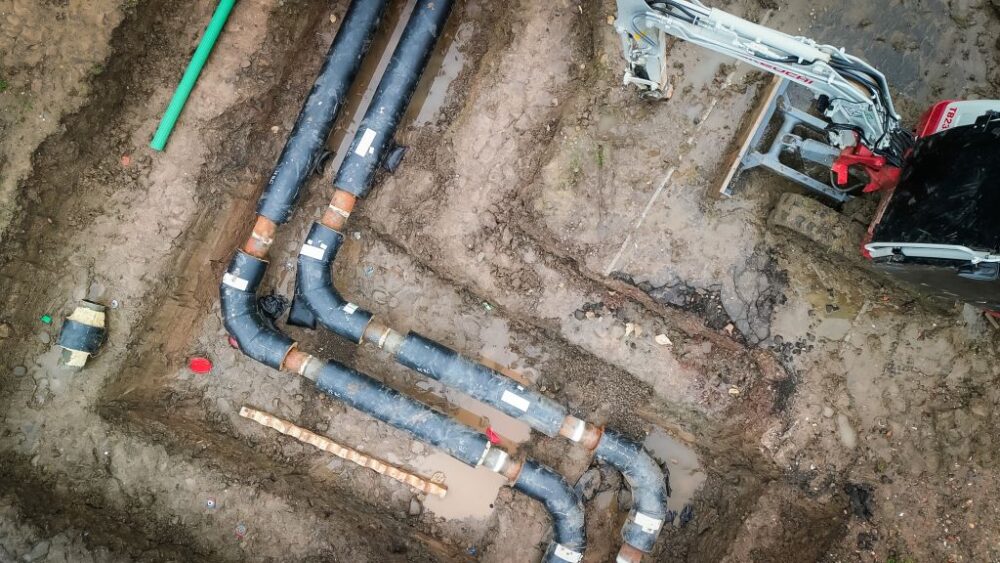
An aerial shot of the Duffryn Heat Network pipes being replaced

Duffryn Heat Network

Upgrading an aging network for Newport City Homes

One if the UK's largest and most ambitious heat network replacement projects

Executive summary

The Duffryn Heat Network has been providing warmth and comfort to residents of the estate for nearly five decades. Recently, however, the aging pipework had begun to affect the customer experience.

To address this issue, Newport City Homes (NCH) embarked on one of the UK's largest and most ambitious heat network replacement projects. The initiative involved replacing 7.5 kilometres of district heating pipework with modern infrastructure to provide residents with a reliable, efficient heating system fit for the 21st century.

What we’ve achieved with this project

7.5km

of pipework replaced

£3.7m

grant from the Heat Network Efficiency Scheme (HNES)

970+

homes, schools, and other buildings connected

Project overview

The Duffryn Heat Network has been serving 970 customers since the mid 1970’s. In recent years the aging pipework had begun to affect the customer experience.

To address the immediate concerns, the housing association conducted a series of repairs to restore heating to residents. Subsequently, they commissioned a thermographic drone survey of the entire estate, which revealed additional issues.

After half a century of operation, the pipework was nearing the end of its reliability. Newport City Homes (NCH), with the aid of a £3.7 million government grant from the Heat Network Efficiency Scheme, engaged Vital Energi to replace the entire 7.5-kilometre network over a nine-month period.

An aerial shot of the Duffryn Heat Network pipes being replaced

Our solution

The heat network draws energy from a nearby biomass energy centre that uses sustainable, locally sourced woodchip, ensuring low-carbon heat provision to residents.

The network upgrade involved installing 3.75 kilometres of flow and 3.75 kilometres of return pipework. Engineers implemented a combination of steel and plastic pipework system.

This extensive project required the connection of 27 substations serving over 970 homes, schools, and other buildings. The complex design incorporated varying pipe sizes, ranging from 200mm mains to 32mm branches across the development.

Because the heat network was causing disruption to the lives of residents, Newport City Homes wanted to deliver this project as quickly as possible. We were able to expediate the procurement process, compress the setting up stage and allocate enough specialist operatives to ensure we delivered to the ambitious deadline.

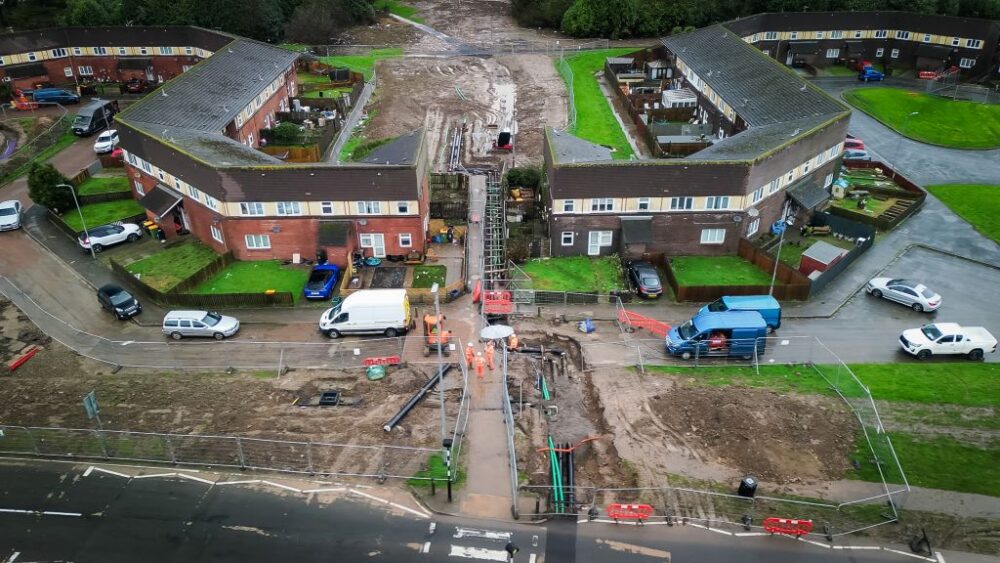
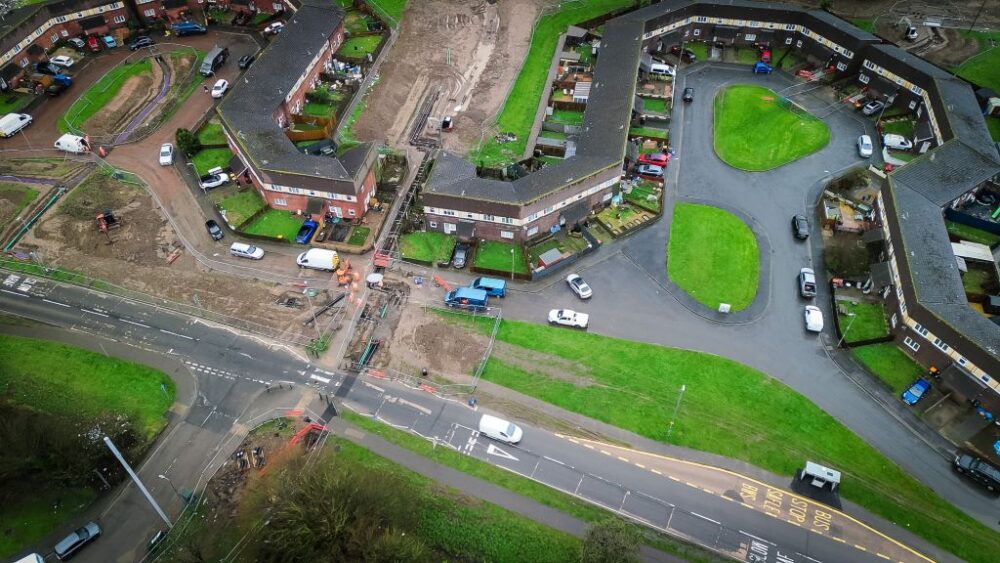
Duffryn Heat Network – new district heating pipes being installed

Project details

An emphasis on quality to ensure reliability

For sizes 200mm down to 65mm, the district heating mains for Duffryn come in 12m lengths of steel mains with a HDPE outer-casing which are welded and jointed.  This is one of the most important steps as any defects in the welding can result in leaks and need costly repairs.  Both Vital and NCH put an emphasis on maximising the reliability and longevity of the installation and ensured the highest quality standards were put in place.

All welders on the project were qualified Class 1, making them the most skilled level of welders and 100% of welds were tested using a  Phased Array Non-Destructive Testing methodology.  This guaranteed each and every weld across the estate was done to the highest standards, and ultimately will lead to maximum longevity for the heat network.

We implemented a hybrid system with the client, so any long singular runs of pipe work 50mm and below were done using a bonded plastic system, that was compatible with the steel connections. This mean we were able to minimise the amount of joints on a number of sections, thus saving potential maintenance issues in the future, but also monitoring each joint where the steel-plastic connection was made with the embedded leak detection wiring that is found within the steel pipe work – therefore providing the client with peace of mind that the entire system was monitor by a highly accurate monitoring system.

Bringing social value

During the pre-construction period, we collaborated closely with our client to develop a comprehensive programme of social value initiatives, fostering strong connections with the local community.  The aim was to leave an impactful, long-lasting legacy which would benefit the community for years to come.

 Our efforts encompassed a wide range of activities, from supporting vulnerable groups to promoting education and environmental awareness.  By building a strong relationship with the housing association, they were able to guide us as to how our contributions could best support the community in areas such as donating Christmas Dinners to the local food bank or funding outreach programmes for the over-55 community to encourage physical activity.

Our engagement extended to local schools, reaching 200 children through various events and supporting Tredgar Primary School with a substantial donation for a forestry centre to promote sustainable practices. 

Our commitment to the community went beyond financial contributions, as we actively sought ways to utilise our skills and resources for the benefit of residents. We prioritised local hiring and spending, installed wildlife-friendly features in the area, and used our logistical expertise to assist charitable organisations. Notable examples include transporting essential appliances to the food bank and supporting the Sparkle charity. These initiatives not only improved the immediate well-being of community members but also laid the groundwork for long-term positive impacts on the local environment and economy.
Ensuring water quality

Safeguarding the water quality in the heat network is one of the most important aspects to ensuring longevity.  Prior to making the system live, we utilised a process called “ice pigging” to flush the pipes of dirt and ensure they were clean. Ice-pigging is a method of pigging, where you send a dense slurry of ice down the pipe to strip all debris that could be present – the benefit of ice-pigging is that the ice forms itself to differing pipe sizes, without the need for sectional open ends to insert different sized pigs.  We then undertook a full BSRIA flush once this process has been completed, adding chemicals upon successful completion of this flush that would stop corrosion and ensure the pipework would meet its full design life.

Creating a considerate construction project

Due to the estate layout and heat network routing, road and pathway closures were unavoidable. Our team collaborated with NCH, the council and local stakeholders to minimise disruptions. We supported the client’s communications strategy, providing timely information about works affecting the public for distribution via various channels. Our staff participated in monthly “Duffryn Update” videos, discussing project progress and benefits.

Crucially, our engineers’ soft skills played a vital role. They engaged with residents, answering questions and building relationships whilst working in their communities. This approach is key to ensuring resident support and engagement, which we apply to all our projects.

One key connection was the local primary school, and we needed to maintain safe access to and from the premises for local school children and their parents.  We were able to work with the head mistress and other staff to ensure minimal impact and built a strong relationship which saw the school compliment us on how we handled the delivery stage.

Overcoming exceptional rainfall to deliver the project on time

2023 was one of the wettest years on record, with 10 named storms and 8 months seeing above-average rainfall.  Despite some months being the wettest on record for 40 years our engineers were able to utilise pumping systems to keep the trenches water free and our team delivered the project on schedule.

One negative of this rainfall was that much of the excavation works was done on soft ground, making mud and dirt a potential issue for residents.  Our team put an emphasis on ensuring no dirt or mud found its way into the public areas and hired a road sweeping truck which was driven around the site constantly during working hours to guarantee a safe environment for both our operatives, and the public.

Change-overs

Whilst installing the new mains, it was imperative that the existing mains stayed operational so that heating & hot water could continue to be provided to all the residents. Whilst installing the new pipe work across the site, we had to carefully navigate around the 50 year old existing pipe work, ensuring that at any cross overs we excavated with caution so not to disrupt the live pipe. Once the new pipework was installed, we had to swap the residents over onto the new system in a range of street-by-street switchovers.

The process involved cutting out the old pipework and replacing valves, strainers and internal pipework and then integrating the substations onto the network one by one.  We carefully planned each connection, ensured we had the labour and expertise on hand, and completed them well ahead of schedule.

We then did a comprehensive series of processes and tests to ensure the system worked as designed.  This involved getting rid of any trapped air, taking temperature and flow readings. Then, through careful planning, we were able to switch over each connection, at around a rate of 3 per day for the 27 connections, each done during a standard working day (9am to 5pm) meaning that no residents suffered from a loss of service for any significant periods of time.

Restoring the landscape back to its original state

Once the pipework was installed it was important that we restored the landscaping to its original state, which included roads and pathways, but also the green spaces which residents enjoyed.  We used machines to gently grade the ground and restore it like for like and then worked with the council on re-seeding the areas to ensure it met their standards and specifications. We also looked to enhance the bio-diversity of the area, with the introduction of bat & bird boxes, and planting seeds of wildflowers in certain zones.

Similar case studies

Talk to us about your project

Contact Form